

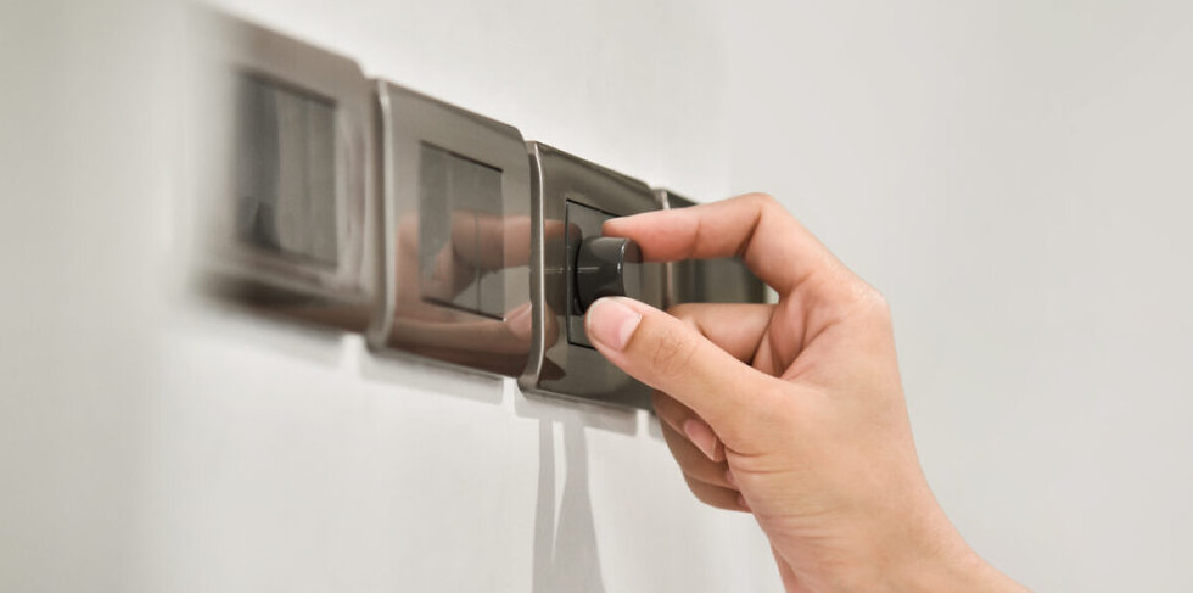
With a dimmer, the brightness of lamps can be adjusted individually. The basic principle behind it: A dimmer ensures that the power supply is specifically regulated as required by the desired brightness. The change is made either continuously (for example, via the rotary switch in the wall) or in preset levels (as with some light switches and touch dimmers).
If you want to use a dimmer at home, it has the following advantages:
- Easily adjust brightness
- adjustment of the light to the individual mood
- lower energy consumption
- lower energy costs
How Does a Dimmer Work?
We use alternating current at home for conventional electrical appliances and lights. This has the peculiarity that it changes its polarity at regular intervals, i.e. it “flows” in a different direction.
An element built into the dimmer (known as a “triac”) switches the current on and off at very fast intervals. This switching on and off is achieved by controlling the so-called load.
What Types of Dimmers are There?
There are different types of dimmers, which are used depending on the light source. They differ in the way they work.
- Phase-angle dimmers: Dimmers with a phase-angle principle are suitable for classic light bulbs. With a phase-angle dimmer, the current is switched on with a delay after the zero crossing until it flows to the next zero crossing.
- Phase-cut dimmer: The mode of operation of phase-cut dimmers, on the other hand, is exactly the opposite: The current starts to flow directly after the zero-crossing and ends before it reaches the next zero-crossing. The control electronics for trailing-edge phase dimmers are somewhat more complex than for leading-edge phase dimmers.
- TRONIC transformers: These work according to the phase-angle principle.
- LED dimmers: Since LEDs are increasingly replacing classic incandescent lamps in households, dimmers are also specially designed for LEDs.
- Universal dimmers: These are used to control the connected load accordingly
How are Dimmers Controlled?
- The popular touch dimmers, which are often found in dimmable floor lamps or table lamps, allow the brightness to be regulated according to certain levels. Depending on the model, different numbers of dimmer levels can be selected.
- Touch dimmers allow easy control with the touch of a finger.
- Dimmers with remote control are particularly convenient and also control the desired brightness in steps. However, you should make sure that the light can still be dimmed without the remote control; otherwise it can quickly happen that you can no longer dim it at all if you lose the remote control.
- With rotary dimmers and sliding dimmers, you can continuously set the exact brightness you want.
Which Dimmer is the Right One?
An indication of which dimmer is suitable for which lamps is given by the respective load the dimmer is designed to control.
A horizontal triangle indicates that the brightness of the lamp can be adjusted; there are also different letter symbols for the various versions:
Hi, this is a comment.
To get started with moderating, editing, and deleting comments, please visit the Comments screen in the dashboard.
Commenter avatars come from Gravatar.